A Leadership Pattern for Resilient Systems
Systems Evolve in Ways We Cannot Predict
Incidents in mature systems rarely originate from a single bug. More often they emerge from the natural evolution of software over time. Early in a product’s life the architecture behaves predictably because workflows are limited and interactions between systems are relatively simple. As the platform grows, new services, features, and business processes introduce combinations of behavior that were never considered when the original workflows were designed.
Each additional capability expands the number of paths work can take through the system. Events trigger additional processing, dependencies form between services, and integrations introduce timing and reliability characteristics outside the control of the engineering team. None of these changes are problematic in isolation. Complexity emerges from the accumulation of interactions across the system.
The result is not necessarily more failures, but more situational behavior. Mature systems rarely fail consistently. Instead they fail intermittently depending on timing, event ordering, or specific combinations of data. Infrastructure may remain perfectly healthy while a workflow enters a state the system no longer understands how to resolve.
For engineering leaders this pattern is inevitable. Systems that evolve long enough will eventually encounter states their designers never anticipated. Resilience therefore depends not only on preventing failure, but on ensuring humans can understand what occurred and guide the system back to a valid state.
Heroics Are Not a Recovery Strategy
When a system enters an unexpected state, escalation happens quickly. Revenue may be impacted, customers report issues, and leaders push for rapid resolution. When the system stops moving, organizations wake up their most senior engineers. The people most likely to understand the system are asked to get it moving again.
The first objective is rarely root cause analysis. The immediate priority is symptom relief. A quick patch is deployed so the workflow can continue even though the underlying cause may still be unknown.
Only after the immediate pressure subsides does the deeper investigation begin. Engineers work to identify the root cause, determine what should have happened, and understand how the system entered an inconsistent state. Once the cause is understood, another change may be required to prevent recurrence. Engineers then need to repair any broken processes or records created while the system was inconsistent.
What began as a single operational issue expands into hours or days of additional work. Senior engineers are repeatedly pulled away from delivering outcomes and instead pay the penalty of context switching to repair production state.
Over time this pattern creates a hidden dependency inside the organization. The system may appear stable, but its resilience depends on a small number of engineers who know how to repair it under pressure. Organizations unintentionally design systems that rely on heroics rather than recovery.
Admin Console: Designing Systems Humans Can Guide
If heroics are the only recovery mechanism, the architecture is missing an important capability. Mature systems inevitably encounter states their designers did not anticipate. Engineers must be able to observe system behavior and guide it back toward stability without emergency patches or manual database manipulation.
This is where the Admin Console becomes an essential architectural capability.
The Admin Console is not simply an internal dashboard or support interface. It is a centralized operational control surface where engineers interact with the system through the same commands and workflows the domain itself uses. Instead of bypassing business logic, engineers guide the system using mechanisms already built into the architecture.
A stalled workflow can be retried through its intended command. A missing event can be republished so downstream processing occurs naturally. Recovery follows the same domain pathways used during normal operation.
Operational ownership should remain with the domains themselves. Each team exposes the commands and controls required to guide the workflows they own. As organizations grow, the Admin Console can evolve into a centralized surface composed of domain‑contributed capabilities. Techniques such as micro frontends allow teams to contribute operational tools without creating coordination bottlenecks.
This philosophy reflects what many engineers describe as the “lazy engineer” principle. If the system cannot recover safely, someone will eventually wake up and repair it manually. Designing operational controls directly into the domain avoids placing engineers in that position.
Resilient systems also recognize that uncertainty is highest when new capabilities are introduced. Temporary monitoring and operational controls allow teams to observe new workflows closely until confidence grows.
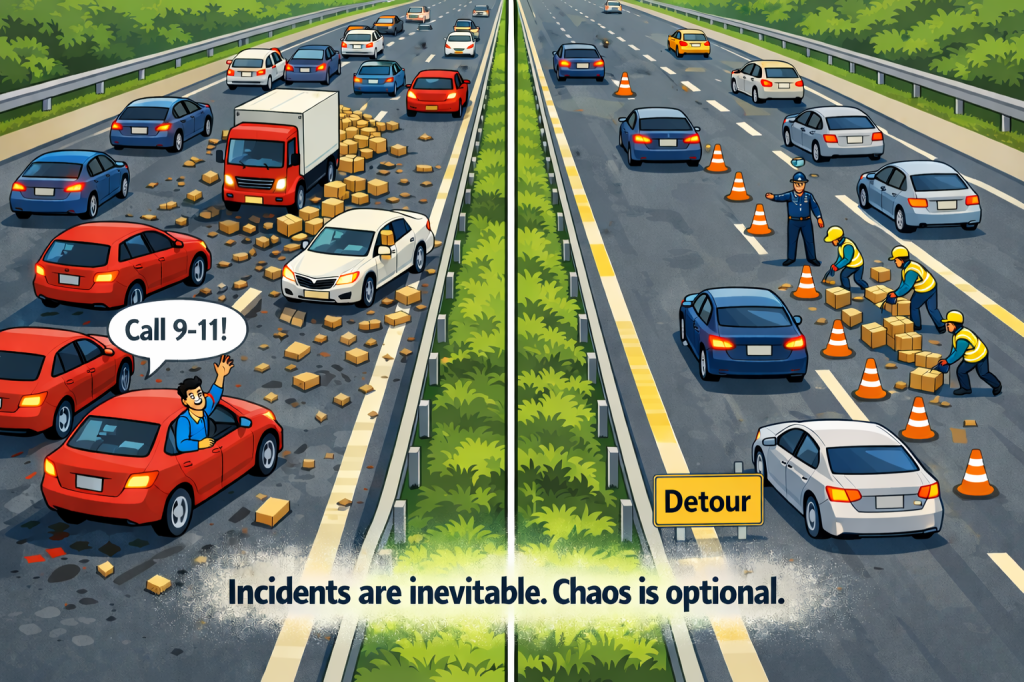
The result is not the elimination of incidents but a shift in how they are experienced. Instead of a chaotic scramble, engineers gain visibility and controlled mechanisms to guide the system. Ownership becomes practical because engineers have the tools required to operate the systems they build.
Admin Console Reflects Leadership Decisions About Resilience
Admin Console is not only a technical capability. It is also a reflection of leadership. Leaders who design systems with resilience in mind ensure engineers have the tools to guide those systems when something goes wrong. This reflects a commitment to organizational resilience, not just feature delivery.
Strong engineering leaders recognize that complex systems will eventually fail in ways nobody predicted. Their responsibility is not to eliminate failure but to ensure the organization can respond without panic, burnout, or prolonged disruption.
Leaders who think this way deliberately create operational escape paths. Teams can stabilize workflows, limit the spread of failures, and continue operating while deeper issues are investigated.
This thinking extends to catastrophic scenarios where large portions of the technology environment may become unavailable or compromised during a security breach. In these moments organizations benefit from a minimum viable company mode—a reduced set of capabilities that allows the organization to operate while compromised systems are isolated and stability is restored.
Admin Console supports this philosophy by providing a recovery path that does not depend on improvisation. The system itself provides a path back to stability, allowing engineers to guide operations deliberately rather than scrambling to reconstruct what should have happened.
When these capabilities exist, the organization can stabilize systems, investigate problems thoughtfully, and continue moving forward without sacrificing its most valuable engineers to constant firefighting. Resilient systems are those designed so engineers can guide the organization safely through failure.

