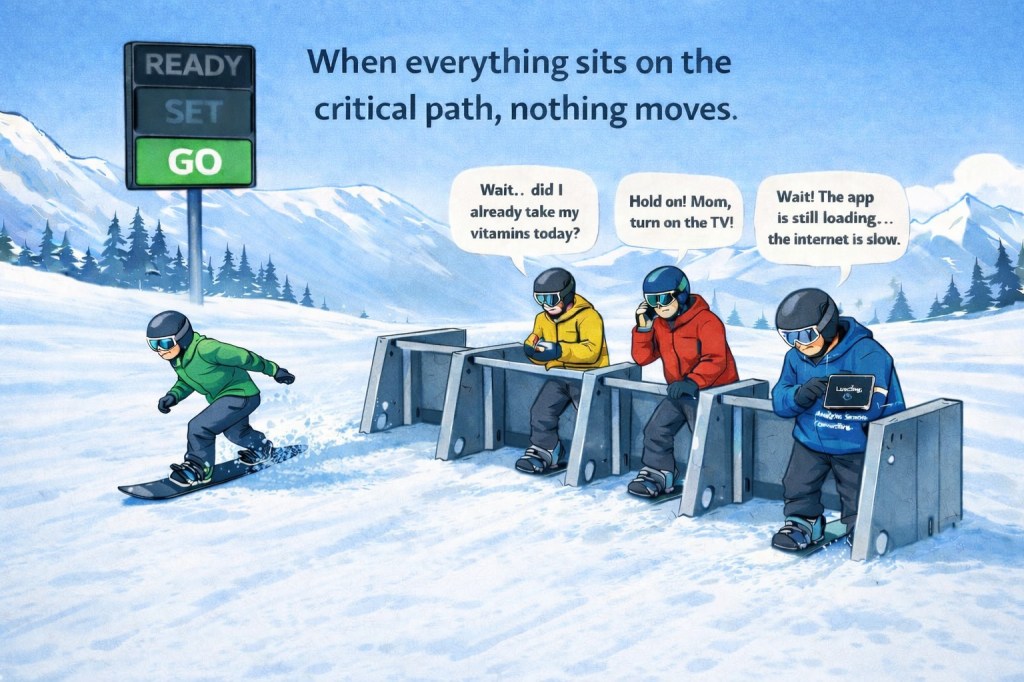
When Everything Is on the Critical Path, Nothing Moves
How Event‑Driven Architecture Restores Autonomy to Systems and Teams
If a marketing system, logging service, or email provider can prevent a customer from completing a purchase, your architecture has placed too much on the critical path. Systems that begin with good intentions slowly accumulate dependencies until nearly every capability participates in completing a transaction. What started as integration eventually becomes entanglement. The result is a system where progress depends on the health and coordination of far more components than the business outcome actually requires.
When everything participates in the transaction, every dependency quietly gains veto power over the business. A timeout in logging delays account creation. A marketing integration blocks a trial activation. An email provider outage suddenly becomes a revenue-impacting incident. None of those systems define the business milestone, yet they have been allowed onto the critical path anyway.
Teams often treat these failures as reliability problems, but the deeper issue is structural coupling. The architecture has blurred the line between completing a business outcome and informing the rest of the system that it happened. Once those responsibilities are mixed together, transaction flows begin to accumulate orchestration code—retries, fallbacks, circuit breakers, and compensating logic—most of which has little to do with the business milestone itself. Over time the real intent of the system becomes buried under plumbing.
Event‑Driven Architecture begins with a simple structural shift. Domains declare business milestones once the responsibility of that domain has been satisfied. Other capabilities learn about those milestones after the fact and react independently. While this approach is often described as an integration pattern, the real impact is organizational because it shapes how teams interact and how systems evolve as the company grows.
Decoupling Completion from Reaction
A milestone represents a meaningful change in business state—OrderPlaced, AccountActivated, BundlePurchased, TrialExpired. The domain that owns that state declares the milestone once its responsibility is fulfilled, and ownership of that meaning is explicit rather than implied. Once the milestone is declared, other capabilities can respond in their own time because the business outcome has already occurred and the rest of the system is simply becoming aware of it.
Email confirmation may follow the purchase. Analytics systems may record the behavior. Marketing systems may begin engagement campaigns, and fulfillment may start preparing the shipment. None of those capabilities determine whether the purchase happened; they simply react to the fact that it did. By separating completion from reaction, the system ensures that only the capabilities that truly define the milestone sit on the critical path.
This shift produces structural advantages that compound as organizations grow. The critical path becomes smaller and easier to reason about because only the systems that define the milestone participate in the transaction. Failures in downstream capabilities become recoverable operational issues rather than catastrophic blockers of the business outcome. The system still reacts to those failures, but they no longer prevent the milestone from occurring.
The second advantage is that the surface area of change becomes dramatically smaller. New capabilities can attach themselves by reacting to declared milestones rather than modifying transaction flows. Engineers no longer need to understand every downstream system before making a change because the architecture has already limited what belongs on the critical path. That reduction in required knowledge removes a surprising amount of friction from day‑to‑day development.
What organizations often interpret as delivery slowdown caused by scale is often coordination sprawl hidden inside transaction flows. Every change requires teams to understand who else might be affected, which systems might break, and which dependencies must be consulted before code can ship. The real burden is cognitive load—the constant need to reason about downstream impact before touching the system.
Milestones reduce that cognitive load by design because they clearly define what completes the business outcome and what merely reacts to it. Teams gain clarity about where change is safe and where coordination is actually necessary. Over time this clarity becomes one of the most valuable properties an architecture can provide.
Polling Is Structural Debt
In systems that never formally declared their milestones, downstream capabilities attempt to detect change indirectly. They poll databases, query APIs, or repeatedly inspect state to infer whether something might have happened. This approach often emerges organically when teams need awareness but the system never provided a clear signal that a milestone occurred.
Polling increases infrastructure cost, unnecessary load on primary databases, and latency between action and awareness. The deeper problem, however, is that polling loses causality. If state changes multiple times between polling intervals, the system captures only the most recent snapshot while the intermediate transitions disappear entirely. Sequence is lost and the narrative of how the system arrived at its current state becomes invisible.
Snapshots show where the system is. Milestones show how it got there. Without those milestones, other systems are forced to reverse‑engineer meaning from incomplete evidence. Polling therefore becomes a symptom of architectural hesitation—a system that never formalized its important business moments.
Events as a Behavioral Ledger
Once milestones are consistently declared, the system gains something more powerful than simple integration. It gains memory in the form of a chronological record of meaningful business events. Instead of reconstructing activity from logs or database diffs, teams can observe the actual journey through the system as it unfolded.
A stream of milestones such as UserLoggedIn, AddressUpdated, EligibilityCalculated, BundleApplied, and PaymentDeclined forms a behavioral ledger. Two customers may end in the same final state, but the path that led them there often tells the real story.
Trajectory reveals friction, sequence reveals intent, and support, marketing, and growth teams can see exactly how problems or opportunities emerged rather than reconstructing them after the fact.
This ledger becomes even more valuable as AI begins participating in business workflows. Each inference becomes part of the observable history of the system: which model was invoked, what context was provided, what decision was returned, and which action followed. Without declared milestones those decisions tend to disappear into logs, making governance and evaluation far more difficult.
Events as a Reactive Control Plane
A durable stream of milestones also creates the foundation for clean and independent reaction across the organization. Systems can subscribe to meaningful signals without inserting themselves into the transaction that produced them. The architecture therefore supports new capabilities without forcing existing ones to coordinate every change.
Marketing platforms can respond to AccountActivated without modifying product logic. Risk systems can react to FraudIndicator events without blocking checkout, and AI models can adjust decisions in response to real‑time signals such as traffic patterns or inventory changes.
These signals can also allow systems to prepare the next interaction before the user explicitly asks for it. A login milestone might trigger personalization services to prepare recommendations, pricing systems to calculate eligible offers, or profile services to hydrate context that will be needed moments later. By the time the user navigates deeper into the product, the system has already prepared parts of the experience in the background. This preparation happens off the critical path, so if a recommendation engine or offer generator fails, the user can still complete the core interaction without disruption.
Because these reactions occur outside the critical path, experimentation becomes both safer and faster. New capabilities can be introduced as subscribers while older ones can be retired without destabilizing the system’s core behavior.
Operational Truth in Motion
When milestones are emitted consistently, they form a stream of operational truth in motion. That stream can flow directly into analytical platforms or lakehouse architectures without complex ETL pipelines attempting to reconstruct behavior from snapshots.
Understanding position is useful, but understanding progression is strategic. Sequences reveal causality, allowing organizations to forecast outcomes, improve models, and identify friction in customer journeys that would otherwise remain hidden inside aggregate metrics.
Milestones preserve narrative while snapshots preserve only state. Systems that understand narrative gain a much deeper understanding of behavior.
Relationship to Domain‑Driven Design
Event‑Driven Architecture does not require Domain‑Driven Design, and many systems emit events without carefully defining their domain boundaries. When milestones are not declared by the domain that actually owns the business meaning, however, the resulting event stream often reflects accidental state changes rather than intentional signals.
Domain‑Driven Design clarifies who owns meaning by establishing boundaries, language, and responsibility across the organization. Event‑Driven Architecture then allows that meaning to propagate once it is declared. Together they reinforce autonomy without re‑coupling teams because domains communicate intent while other domains react without interfering in completion.
Declaring, Not Negotiating
Event‑Driven Architecture is often reduced to messaging infrastructure or streaming platforms, but that misses the real shift. Those technologies matter, but they are not the real shift. The real shift is structural: deciding whether systems must negotiate completion with every dependency or whether domains can declare milestones and allow others to react afterward.
When every dependency must participate in completing a transaction, systems become fragile and organizations must negotiate every change. Teams cannot move without checking who else might be affected because the architecture itself requires coordination.
When domains declare milestones and allow other capabilities to react independently, the system behaves very differently. Teams listen for signals instead of coordinating every move. New capabilities attach without rewriting core flows, and the organization becomes more adaptable because autonomy is built directly into the architecture.
In the end, architecture mirrors culture—and the decisions embedded in systems quietly shape how teams work. If your systems require constant coordination, your teams will as well. If your systems emit clear signals that others can react to independently, teams gain the freedom to move without asking permission every time they evolve the product. The architecture you design quietly determines which kind of organization you become.
 Built To Last Engineering