Every founder eventually reaches a moment when the company’s bottleneck shifts from building the product to building the organization. Features can be shipped faster, customers are growing, and the engineering team is expanding. The friend you brought in early because you were both rallying around an idea may not be able to build you a larger team. Scaling people and processes requires a different skill set than scaling code. That’s when the question arises:
Who should lead engineering?
Many founders default to familiar titles: CTO, VP of Engineering, CIO. But those roles often represent maturity stages that a startup hasn’t yet reached. In a growing company, what’s needed most is not hierarchy, but hands-on leadership. Someone who can architect not only systems, but also teams and culture. Someone who can balance the immediacy of delivery with the long view of sustainability.
That’s the moment to hire your Head of Engineering.
Why the Head of Engineering Is Different
The Head of Engineering isn’t the executive in the ivory tower, nor the lone architect buried in code. They are a rare hybrid, part builder, part guide, part partner, who bridges the world between engineering execution and business vision.
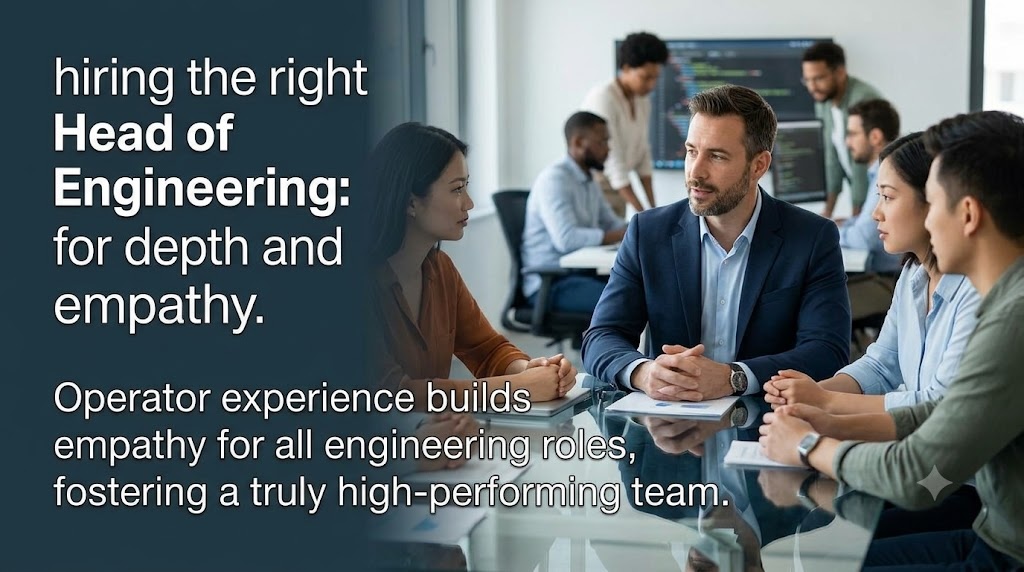
They’ve lived many lives: they’ve written production code, carried a pager through late-night outages, mentored junior engineers, and designed architecture under pressure. They created product vision, wrote training manuals, automated CI/CD steps, and lead a Go To Market playbook. Their empathy for every role within engineering comes from having done the work themselves.
They’ve seen how engineering evolves across stages: the chaos of early startup life where duct tape counts as infrastructure, the growing pains of mid-stage companies introducing structure, and the rigor of mature organizations balancing innovation with governance. They know what needs to change as you scale, and what must never be compromised.
Most importantly, a great Head of Engineering leads with humility. They know they’re not the smartest person in every room and that’s the point. They hire leaders who complement their blind spots. They build leadership teams that think differently, challenge each other respectfully, and make better collective decisions.
And they partner not just manage. A true Head of Engineering collaborates with the Head of Product and Head of Operations as an equal. They balance ambition with feasibility, idealism with pragmatism. They challenge both founders and engineers when needed, not for control, but for clarity.
Hiring a Head of Engineering doesn’t preclude your company from eventually bringing on a CTO or VP of Engineering. In fact, the best Heads of Engineering evolve alongside the company, sometimes stepping into those titles, sometimes finding renewed purpose in shaping culture, building an innovation lab, or mentoring the next generation of leaders. Their north star is never the title. It’s the impact.
The Empathy Advantage
Engineering organizations thrive when leaders understand the work and the people behind it.
A great Head of Engineering knows that every line of code represents more than logic. It represents human effort: a developer balancing tight deadlines, debugging through frustration, or quietly celebrating a breakthrough that no one else will ever see.
But empathy in engineering leadership goes beyond having written code.
Strong Heads of Engineering have operated in roles adjacent to engineering or have at least felt their pressure. They understand that managing expectations is just as critical as meeting delivery commitments. They know that what engineering ships often comes with nuance that must be taught to support, sales, or operations. They recognize that some corners simply cannot be cut because security, reliability, or trust may matter more to the company than hitting a date.
This broader perspective is what turns empathy into leverage.
Empathy transforms teams. It turns transactional execution into shared ownership. It motivates people to go the extra mile not out of fear or obligation, but out of belief, the belief that their work matters and that they matter.
Empathy isn’t soft; it’s strategic. It’s a force multiplier that drives trust, loyalty, and innovation. Startups, with their relentless pace and constant uncertainty, are fertile ground for burnout. Empathy is what sustains energy through long nights, shifting priorities, and imperfect plans.
Importantly, empathetic leadership does not mean avoiding hard conversations. It means approaching them with curiosity and humanity.
When a deadline slips, an empathetic leader doesn’t start with blame. They start with why:
“What’s blocking us?”
“What do you need to succeed?”
“How do we solve this together?”
That shift in tone turns fear into partnership, and partnership into psychological safety. Psychological safety, in turn, is what enables engineers to surface issues early, take responsible risks, and innovate without fear of punishment.
The impact of empathy shows up in measurable ways:
- Retention and loyalty — People stay where they feel seen and valued.
- Better decision-making — Diverse perspectives are heard, reducing blind spots.
- Cross-functional collaboration — Empathy bridges product, design, and sales by translating between competing priorities.
- Innovation through inclusion — A safe team is a creative team.
- Resilience under pressure — Calm leaders create calm systems.
Empathy paired with action is what makes it powerful.
I once worked in an organization plagued by constant delivery issues. Engineers across multiple teams were committing over each other, tests were failing, and finger-pointing over who broke the build was happening several times a day. Morale suffered, velocity dropped, and trust eroded.
As an engineer, the patterns were familiar. The fixes were well understood: feature branches, merge windows, enforced unit and integration tests. But the team resisted. Tthey wanted the speed of committing directly to the main branch.
Instead of mandating process from above, I pulled the technical leads into a working huddle. We pressure-tested ideas together until someone surfaced a tool that automatically built the code and ran all tests on every merge. The system made it immediately clear whose change broke the build and just as importantly, made it easy for that person to fix it.
Accountability became clear without becoming personal. The finger-pointing stopped. Quality improved. Ownership returned.
That’s what empathy looks like in practice. Not lowering standards, but raising them in a way people can meet. Not shielding teams from accountability, but creating systems that make accountability fair, visible, and constructive.
Empathy isn’t about being nice. It’s about creating the conditions where people can do their best work and where the organization gets the outcomes it actually needs.
Humility in Leadership
If empathy builds trust, humility sustains it.
Humility allows leaders to admit what they don’t know, listen more than they speak, and create space for others to shine. In fast-scaling environments, it’s tempting for leaders to feel pressure to have every answer. In reality, the faster a company grows, the more valuable it becomes to have a leader who can say, “I don’t know yet, but let’s figure it out together.”
Humility isn’t indecision. It’s intellectual honesty.
When practiced consistently, humility creates:
- Adaptability — Technology evolves; humility ensures learning never stops.
- Collaboration — Authority becomes service, and leadership becomes enablement.
- Psychological safety — Leaders who own mistakes model accountability.
- Balanced decision-making — Ego doesn’t cloud trade-offs between speed and quality.
I’ve also seen what happens when humility is absent.
In some organizations, leaders shut down conversation simply by how they speak about other teams or individuals. They publicly reward agreement while quietly sidelining dissent. They make decisions based on what they’ve read or already believe, rather than engaging in open dialogue with the people closest to the work.
The result is predictable: silence. People stop offering ideas. Risks go unspoken. Problems surface late, when they’re far more expensive to fix.
One leadership practice I rely on to counter this is simple but intentional. When presenting a problem, I first share my point of view and then I openly list all the reasons I believe my approach might be wrong. Only then do I ask the team for their perspective.
That signal matters. It tells the room that disagreement is not just allowed, but expected. It shifts the goal from defending a position to finding the best answer. And over time, it builds a culture where humility isn’t performative, it’s operational.
The Power of Partnership
The Head of Engineering’s greatest leverage often lies not in technology, but in partnership especially with the Head of Product, Head of Operations and Head of Sales.
When these leaders operate in sync, a company moves in harmony: engineering builds what customers (both external and internal) actually need, and the organizations understand what technology can truly deliver.
The partnership thrives on:
- Shared vision – A north star that both technology and business rally around.
- Constructive challenge – Healthy debate without ego.
- Transparency – Shared wins, shared risks, shared accountability.
- Mutual empathy – Understanding each other’s constraints and pressures.
I once worked on a project to reduce stolen vehicle recovery time. The product request was simple: detect alarm events. But through collaboration, engineering uncovered a better approach: a scoring system using multiple signals to detect anomalies. The result wasn’t just a better product, but a deeper partnership rooted in trust and respect.
Partnership doesn’t mean agreement on everything. It means alignment on purpose. When product and engineering operate as one, the entire organization benefits. Decisions move faster, trade-offs become clearer, and teams feel united under one mission.
Guardrails and North Stars
Speed is the lifeblood of startups but speed without direction becomes chaos.
A great Head of Engineering provides both freedom and focus: guardrails to prevent drift, and north stars to inspire progress.
Guardrails protect integrity. They define what’s non-negotiable: security, ethics, quality. Guardrails don’t limit creativity; they make innovation safer.
North Stars provide meaning. They remind teams why the work matters, aligning individual contributions with collective purpose.
A Head of Engineering’s job is to build that same framework: clarity that empowers rather than constrains.
Because when teams understand the boundaries and the vision, they move fast and move together.
What to Look For When Hiring a Head of Engineering
The strongest Heads of Engineering tend to share a common pattern. It’s not a specific background or a perfect resume, it’s range, judgment, and the ability to lead through influence rather than title.
Look for the following:
- Breadth of experience — They’ve worn many hats: developer, architect, project manager, release lead, and often product partner. This range allows them to see second- and third-order consequences, not just technical trade-offs.
- Stage awareness — They’ve helped organizations grow and understand what must evolve and just as importantly, what should remain stable. They don’t reflexively introduce process; they introduce it when it earns its keep.
- Humility and empathy — They elevate their teams, not themselves. Credit flows outward; accountability flows inward.
- Partnership mindset — They can challenge peers constructively rather than combatively. They seek alignment, not wins, and know when to push and when to listen.
- A clear north star — They consistently anchor technology decisions to mission, customer value, and long-term outcomes, not just short-term delivery.
Beyond resumes and interviews, there’s a simple test that matters more than most signals: do people want to follow them?
Look for evidence of pull, not just placement. Do people, both inside and outside their direct reporting lines, seek opportunities to work with them again? Do former peers and reports describe a leader who created trust, clarity, and growth?
Even in places like LinkedIn recommendations, patterns emerge. A diverse set of voices, across roles and levels, all pointing to the same themes, service, integrity, and shared success is rarely accidental.
Strong leaders leave a wake. Pay attention to what follows them.
Closing Thought
Hiring the right Head of Engineering is one of the most consequential decisions a founder will make. This person is not a stopgap before a CTO, nor a glorified project manager. They are the bridge between code and culture, between execution and vision.
When you find them (someone who blends empathy, humility, and strategic clarity) they’ll do more than build your product. They’ll build your company’s foundation for lasting success.
Hiring the right Head of Engineering is a force multiplier but it is not the work itself.
Even the strongest leader cannot scale through presence alone. Leadership sets intent, but structure determines whether that intent turns into consistent execution or daily friction. Without the right organizational design, accountability becomes unclear, decisions bottleneck, and ownership slowly erodes.
The real test of an engineering leader isn’t what they decide, it’s what the organization can decide without them.
 Built To Last Engineering