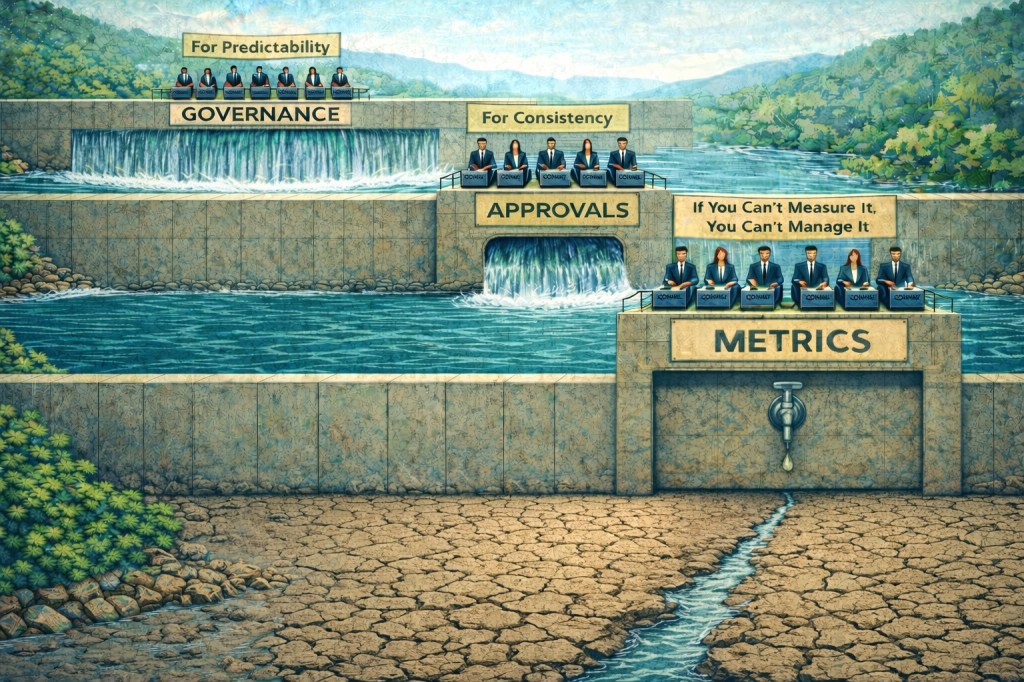
Engineering organizations rarely fail in dramatic ways. There is no single outage, no catastrophic decision, no public reckoning that marks the beginning of the end. Instead, failure arrives quietly through small compromises, missed signals, and leadership decisions that seem reasonable in isolation but corrosive in aggregate.
Most leaders don’t wake up intending to break their engineering organization. They want speed. Predictability. Accountability. They want results they can explain to executives and boards. And so they introduce processes, metrics, and reporting structures designed to create control.
Over time, those mechanisms begin to replace trust.
At first, the changes feel productive. Roadmaps get tighter. Commitments get firmer. Dashboards multiply. Engineers are asked for estimates, then explanations, then justifications. Delivery becomes the focus—not because outcomes are unimportant, but because delivery is easier to measure.
What’s lost in that shift is subtle but profound: intent.
When Output Replaces Purpose
Many engineering teams operate in a world defined by tasks:
- Build this endpoint
- Add this field
- Migrate this service
- Reduce this latency
None of these are inherently wrong. But when work is framed exclusively in terms of what needs to be done, teams stop engaging with why it matters.
Engineers become executors rather than partners. Their job becomes completion, not contribution.
Over time, this changes behavior. Engineers stop asking questions that feel inconvenient. They stop challenging assumptions that slow delivery. They optimize for being “right” within the system instead of being effective for the business.
Leaders often misinterpret this silence as alignment but it isn’t. It’s disengagement.
The Cost of Misaligned Incentives
Engineering organizations are deeply shaped by what they reward explicitly and implicitly.
- When speed is rewarded without regard for sustainability, burnout follows.
- When predictability is rewarded over learning, innovation slows.
- When promotions favor visibility over impact, trust erodes.
I’ve seen organizations where engineers worked heroically to keep systems alive while leadership celebrated velocity metrics that ignored the human cost. Attrition was treated as an unfortunate inevitability rather than a signal. Each departure increased load on those who remained, reinforcing the very conditions that caused people to leave.
This isn’t a people problem. It’s a leadership problem.
Engineering systems behave exactly as they are incentivized to behave.
Control Feels Safe—Until It Isn’t
As organizations scale, leaders often respond by tightening control. Decisions move upward. Exceptions require approval. Architectural choices become centralized. The intent is consistency and risk reduction.
The result is usually the opposite.
When leaders over-rotate on control, they create dependency. Teams wait for answers instead of forming judgment. Engineers disengage from ownership because ownership has been implicitly revoked. The organization slows—not because people are incapable, but because they are constrained.
Ironically, the leaders most worried about chaos often create it by suppressing the very autonomy that allows teams to respond effectively to change.
Burnout Is a Lagging Indicator
By the time leaders talk about burnout, it’s already too late.
Burnout doesn’t start with long hours. It starts with loss of agency. When engineers feel their expertise doesn’t matter, when decisions are made without context, when effort and outcomes feel disconnected, motivation erodes.
People don’t burn out because the work is hard. They burn out because the work feels pointless. And once burnout sets in, no amount of perks, reorgs, or motivational speeches will fix it.
The Quiet Failure Mode
The most dangerous thing about all of this is how normal it feels.
Nothing breaks all at once. Systems still run. Roadmaps still ship. From the outside, the organization appears functional. From the inside, engineers feel unseen, unheard, and increasingly disconnected from the outcomes they’re supposed to own.
Eventually, the best people leave. Those who remain adapt to the system rather than improve it. Leadership interprets this as stability.
It’s not stability, it’s stagnation.
A Different Path Forward
Engineering organizations don’t fail because engineers stop caring. They fail because leaders stop creating the conditions where caring matters.
I’m working on articles and a book about reversing that trajectory—not through platitudes, but through deliberate leadership choices. Choices that re-center purpose, rebuild trust, and treat engineers as partners in outcomes rather than resources for execution.

